Cardiology Board Exam MCQs: 15 High-Yield Questions from the 2025–26 Guidelines
Practice questions with full explanations, drawn from the guideline changes examiners are writing about right now — the 2025 ACS and hypertension guidelines, the 2026 dyslipidemia guideline, and the rewritten ASE echo standards.
Candidates preparing for DM, DNB, or the cardiology boards internationally tend to distribute their effort evenly across the syllabus. Examiners do not. Question writers are drawn disproportionately to material that has recently changed, for the straightforward reason that new guidance discriminates between the candidate who reads current literature and the candidate who memorised a review article three years ago. A recommendation that has been stable since 2018 makes a poor discriminating question. One that reversed eighteen months ago makes an excellent one.
That creates a specific hazard in the current cycle. Between early 2025 and mid-2026 an unusual number of major documents landed: a new ACC/AHA acute coronary syndromes guideline, a new high blood pressure guideline that retired the Pooled Cohort Equations, a multisociety dyslipidemia guideline that restored explicit LDL targets, a rewritten ASE diastolic function guideline, a new ASE right heart guideline, and a revised universal definition of heart failure. Any question bank compiled before 2025 now teaches several answers that are wrong.
The fifteen questions below concentrate on exactly those areas. Work through each one before reading the explanation — retrieval practice produces substantially better retention than recognition, and reading the answer first feels productive while achieving very little. If you want the structured timetable that surrounds this kind of practice, our companion article on the six-month DM cardiology board study plan covers scheduling and revision cycles.
Cardiology Board Exam MCQs:
Section 1 — Acute Coronary Syndromes
Question 1. A 58-year-old man undergoes PCI for NSTEMI with a complex calcified left anterior descending lesion. Regarding intravascular imaging to guide the procedure, which statement reflects the 2025 ACC/AHA ACS guideline?
A. Intravascular imaging is reasonable only when angiography is inconclusive
B. Intravascular imaging carries a Class 1 recommendation for guiding PCI
C. Intravascular imaging should be reserved for left main disease
D. Routine intravascular imaging is not recommended because of contrast burden
Answer: B. The 2025 guideline elevated intravascular imaging to a Class 1 recommendation for guiding PCI, a significant upgrade from prior guidance. The change rests on accumulated randomised evidence — ILUMIEN IV, OCTOBER and RENOVATE-COMPLEX-PCI among others — showing improved stent optimisation and reduced target-vessel failure, particularly in complex lesion subsets. This is a favourite question precisely because the class of recommendation moved.
Question 2. The same patient has no high bleeding risk features. What is the default duration of dual antiplatelet therapy?
A. 1 month, then P2Y12 monotherapy
B. 3 months, then aspirin monotherapy
C. At least 12 months
D. 30 months in all patients
Answer: C. DAPT with aspirin plus a P2Y12 inhibitor for at least 12 months remains the default in ACS without high bleeding risk. The nuance worth holding is that abbreviated strategies — the TWILIGHT and MASTER DAPT lines of evidence — are alternatives for patients at elevated bleeding risk, not the new default for everyone. Candidates frequently over-generalise de-escalation trials into a blanket recommendation, and questions are written to catch that error.
Question 3. A 62-year-old presents with STEMI. Primary PCI to the culprit right coronary artery is successful. Angiography shows a 80% stenosis in the mid-LAD. What does current guidance advise?
A. Medical therapy alone for the non-culprit lesion
B. Complete revascularization, with modality guided by complexity and comorbidity
C. Non-culprit PCI only if angina recurs
D. Immediate CABG referral
Answer: B. The 2025 guideline recommends complete revascularization in both STEMI and NSTE-ACS, with percutaneous or surgical approach chosen according to coronary complexity and comorbidities. COMPLETE established the benefit of non-culprit lesion revascularization after STEMI for cardiovascular death and myocardial infarction. Note the contrast with stable coronary disease, where ISCHEMIA showed no reduction in the primary composite with an initial invasive strategy — the two settings behave differently, and confusing them is a classic examination trap.
Question 4. A patient with STEMI develops cardiogenic shock. Which statement aligns with 2025 recommendations?
A. Intra-aortic balloon counterpulsation improves survival and is first-line
B. Microaxial flow pumps are recommended in selected patients, with attention to vascular access and weaning
C. Mechanical support has no role outside transplant centres
D. VA-ECMO is recommended routinely for all shock patients
Answer: B. The guideline supports microaxial flow pumps in selected patients with cardiogenic shock, explicitly flagging vascular access management and weaning protocols. The DanGer Shock trial provided the first randomised mortality signal for a microaxial device in STEMI-related shock. IABP-SHOCK II remains the reason option A is wrong: routine balloon pump did not reduce mortality.
Section 2 — Lipids and Prevention
Question 5. A 60-year-old with prior MI and diabetes is on maximally tolerated atorvastatin. LDL-C is 82 mg/dL. According to the 2026 multisociety dyslipidemia guideline, the appropriate LDL-C goal and next step are:
A. Goal <100 mg/dL; no change needed
B. Goal <70 mg/dL; add ezetimibe only if LDL-C exceeds 100
C. Goal <55 mg/dL; add a non-statin agent
D. No numeric goal; percentage reduction only
Answer: C. The 2026 guideline restored explicit numeric LDL-C targets — a substantive philosophical reversal from the 2018 percentage-reduction framework. Very high-risk ASCVD carries a goal of <55 mg/dL, other clinical ASCVD <70 mg/dL. Prior MI with diabetes places this patient in the very high-risk category, so a non-statin agent (ezetimibe, a PCSK9 monoclonal, or inclisiran) should be added. The 2025 ACS guideline runs in parallel, recommending non-statin intensification when LDL-C is ≥70 mg/dL on maximal statin after ACS, with a lipid panel four to eight weeks after any change.
Question 6. Regarding lipoprotein(a) measurement, the 2026 guideline recommends:
A. Measurement only in patients with premature ASCVD
B. Measurement only when family history is positive
C. Universal screening of adults at least once
D. Measurement is not recommended as no therapy exists
Answer: C. The guideline now recommends universal adult Lp(a) screening, recognising it as a causal ASCVD factor independent of LDL-C. This is a genuine change from selective testing and an obvious question target. The reasoning holds even though Lp(a)-lowering agents remain investigational: the value lies in risk reclassification and in intensifying modifiable risk factor management.
Question 7. Which risk tool does the 2025 ACC/AHA high blood pressure guideline use for 10-year risk estimation?
A. Pooled Cohort Equations
B. Framingham Risk Score
C. PREVENT equations
D. SCORE2
Answer: C. The PREVENT equations replaced the Pooled Cohort Equations. PREVENT integrates cardiovascular, kidney and metabolic measures, removes race as an input variable in favour of the social deprivation index, and yields improved calibration. If you remember one fact from the 2025 hypertension guideline for an examination, make it this one — it is the single cleanest discriminating question available from that document, and the same equations now underpin risk-based decisions in the 2026 lipid guideline.
Question 8. A 45-year-old has repeated BP readings of 134/84 mm Hg. PREVENT 10-year risk is 4%. After 4 months of documented lifestyle modification, BP remains 133/84 mm Hg. The next step is:
A. Continue lifestyle measures alone indefinitely
B. Initiate antihypertensive pharmacotherapy
C. Repeat assessment in 2 years
D. Start therapy only if BP exceeds 140/90 mm Hg
Answer: B. For BP of 130–139/80–89 mm Hg with lower estimated risk (PREVENT <7.5%), the guideline advises initiating pharmacotherapy if 3 to 6 months of lifestyle change fails to bring BP below 130/80. This represents a deliberate shift toward earlier treatment in younger, lower-risk patients, motivated in part by the accumulating relationship between midlife BP and later cognitive impairment. The overall target of <130/80 mm Hg was reaffirmed rather than changed.
Section 3 — Echocardiography
Question 9. Under the 2025 ASE diastolic function guideline, which set constitutes the three primary variables in sinus rhythm?
A. E/A ratio, deceleration time, IVRT
B. e′ velocity, E/e′ ratio, TR velocity
C. LA volume index, pulmonary vein S/D, E/A ratio
D. LA strain, IVRT, deceleration time
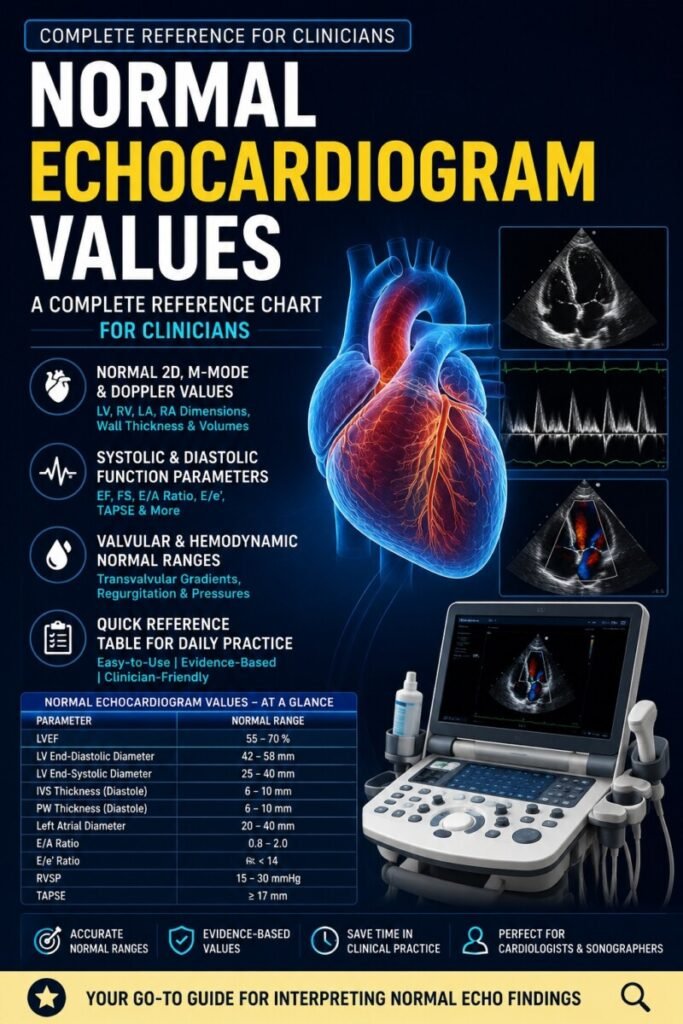
Answer: B. The 2025 algorithm assesses e′ velocity, E/e′ and TR velocity simultaneously, rather than running the 2016 stepwise cascade with separate entry points for normal and reduced ejection fraction. Abnormal thresholds are septal e′ ≤6 cm/s, lateral e′ ≤7 cm/s or average ≤6.5 cm/s; septal E/e′ ≥15, lateral ≥13 or average ≥14; and TR velocity ≥2.8 m/s. LA volume index, LA strain, pulmonary vein S/D and IVRT are now supplementary variables applied when the primary trio is equivocal.
Question 10. Which LA reservoir strain value supports elevated left atrial pressure?
A. ≤8%
B. ≤18%
C. ≤28%
D. ≥35%
Answer: B. LA reservoir strain ≤18% is the supplementary threshold supporting elevated LA pressure. Its formal entry into the algorithm is arguably the most practically consequential change in the 2025 document — LA strain complements E/e′ and performs comparatively well when annular velocities are unreliable, such as with mitral annular calcification, prosthetic rings or regional wall motion abnormality involving the basal segments.
Question 11. A patient in atrial fibrillation requires assessment of filling pressures. Which statement is correct regarding the 2025 guideline?
A. Diastolic assessment is not possible in AF and should not be attempted
B. The standard sinus-rhythm algorithm applies unchanged
C. A dedicated algorithmic pathway exists for AF
D. Only invasive measurement is acceptable
Answer: C. A deliberate addition in 2025 was disease-specific pathways for atrial fibrillation, pulmonary hypertension, mitral annular calcification and heart transplant recipients. These are precisely the populations in which the 2016 algorithm most often returned an indeterminate result. Practically, in AF you average across multiple cycles and lean on E/e′, TR velocity, IVRT and deceleration time rather than E/A and LA volume, both of which are confounded.
Question 12. Regarding the 2025 ASE right heart guideline, which statement is true?
A. TAPSE and FAC are now reported as normal or abnormal only
B. Parameters now carry four-tier severity grading
C. TAPSE has been withdrawn as a recommended measure
D. RA area replaces RA volume index as the preferred measure
Answer: B. The 2025 right heart guideline, framed around pulmonary hypertension, replaced binary cutoffs with graded severity — normal, mild, moderate, severe. Normal thresholds are largely unchanged (TAPSE ≥17 mm, RV S′ >9.5 cm/s, FAC >35%, RV basal diameter <41 mm), but reporting now conveys magnitude. Note also that RA volume index by method of discs (<30 mL/m²) is now preferred over RA area, making option D the reverse of the truth.
Section 4 — Heart Failure, Rhythm and Valves
Question 13. A 66-year-old with HFrEF (LVEF 28%), NYHA II, eGFR 52, and potassium 4.4 is on ramipril and bisoprolol. Which change is most appropriate?
A. Add digoxin
B. Switch ACE inhibitor to sacubitril/valsartan and add an MRA and an SGLT2 inhibitor
C. Add ivabradine and reassess in 6 months
D. Refer for CRT irrespective of QRS duration
Answer: B. Contemporary HFrEF care rests on four pillars: an ARNI (or ACE inhibitor/ARB), a beta-blocker, an MRA, and an SGLT2 inhibitor. PARADIGM-HF established ARNI superiority over enalapril; DAPA-HF and EMPEROR-Reduced established SGLT2 inhibitor benefit irrespective of diabetes status; EMPHASIS-HF supports MRA use in mild symptoms. Current practice favours early initiation of all four at low dose followed by uptitration, rather than sequential maximisation of one agent at a time — STRONG-HF supports rapid uptitration. Ivabradine applies only with sinus rhythm and heart rate ≥70 despite maximally tolerated beta-blockade; CRT requires QRS criteria.
Question 14. A 74-year-old with AF, hypertension and prior TIA undergoes PCI with a drug-eluting stent for NSTEMI. The most appropriate antithrombotic strategy is:
A. Indefinite triple therapy with warfarin, aspirin and clopidogrel
B. DOAC plus clopidogrel, with aspirin limited to a short peri-procedural period
C. DAPT alone without anticoagulation
D. DOAC monotherapy from discharge
Answer: B. The consistent finding across PIONEER AF-PCI, RE-DUAL PCI, AUGUSTUS and ENTRUST-AF PCI is that dual antithrombotic therapy — a DOAC plus a P2Y12 inhibitor — reduces bleeding without a convincing increase in ischaemic events compared with triple therapy. AUGUSTUS was the cleanest demonstration through its two-by-two factorial design, isolating both the anticoagulant and the aspirin question. Aspirin is generally limited to the peri-procedural period through to about one week. This patient’s CHA₂DS₂-VASc is at least 5, so anticoagulation cannot simply be omitted.
Question 15. A 79-year-old has aortic valve area 0.8 cm², mean gradient 28 mm Hg, LVEF 55%, and stroke volume index 29 mL/m². The correct interpretation is:
A. Moderate aortic stenosis; reassure and review in 12 months
B. Measurement error; repeat the study
C. Possible paradoxical low-flow, low-gradient severe AS; proceed to further evaluation
D. Severe AS; proceed directly to valve replacement without further assessment
Answer: C. Valve area in the severe range with a discordantly low gradient, preserved ejection fraction and stroke volume index below 35 mL/m² defines paradoxical low-flow, low-gradient severe aortic stenosis. It typically occurs in small, hypertrophied, poorly compliant ventricles, often in elderly women with hypertension. The correct next step is further characterisation — CT calcium scoring is the usual arbiter with preserved EF, whereas dobutamine stress echocardiography is used when EF is reduced to distinguish true-severe from pseudo-severe disease. Reporting this as moderate stenosis is the common and consequential error.
The Changes Most Likely to Appear
If revision time is short, these are the items with the highest ratio of examination yield to reading effort.
| Area | What changed | Source |
|---|
| PCI guidance | Intravascular imaging elevated to Class 1 | 2025 ACC/AHA ACS |
| Revascularization | Complete revascularization recommended in STEMI and NSTE-ACS | 2025 ACC/AHA ACS |
| Risk estimation | PREVENT equations replace Pooled Cohort Equations | 2025 ACC/AHA HBP |
| Lipid targets | Numeric LDL-C goals restored (<55 / <70 mg/dL) | 2026 dyslipidemia |
| Lp(a) | Universal adult screening recommended | 2026 dyslipidemia |
| Diastolic function | Three simultaneous primary variables; LA strain ≤18% | 2025 ASE |
| Right heart | Four-tier severity grading replaces binary cutoffs | 2025 ASE |
A note on question-bank hygiene. If you are revising from material compiled before 2025, at least four of the fifteen answers above would be marked wrong by that material. Before trusting any bank, check the edition date against the guideline dates in the table — an out-of-date bank does not merely fail to help, it actively teaches errors you will then defend in a viva.
Practise at volume
Fifteen questions demonstrate the pattern; passing requires far more repetition. The Complete Cardiology MCQ Guide contains 5,330 board-style questions with explanations across the full syllabus, and the Board Examination Bundle pairs it with quick-revision notes for candidates preparing for DM, DNB, USMLE and international cardiology boards.
Also see our companion article on building a six-month DM cardiology board study plan, which covers how to schedule question practice alongside reading and revision.
References
2025 ACC/AHA/ACEP/NAEMSP/SCAI Guideline for the Management of Patients With Acute Coronary Syndromes. Circulation. 2025.
2025 ACC/AHA Guideline for the Prevention, Detection, Evaluation and Management of High Blood Pressure in Adults. JACC. 2025.
2026 ACC/AHA/Multisociety Guideline on the Management of Dyslipidemia. JACC. 2026.
Nagueh SF, et al. Recommendations for the evaluation of left ventricular diastolic function by echocardiography and for HFpEF diagnosis: an update from the American Society of Echocardiography. J Am Soc Echocardiogr. 2025.
2025 ASE Guidelines on Echocardiographic Evaluation of the Right Heart with Focus on Pulmonary Hypertension. 2025.
These questions are written for educational use by qualified medical professionals and postgraduate trainees. They are not affiliated with, endorsed by, or reproduced from any examination body. Always verify management decisions against the current full guideline text.