
Acute stent thrombosis appears on every interventional cardiology board blueprint and on a surprising number of general cardiology papers, because it tests three things at once: a classification system, a mechanism map and a management algorithm. Examiners like acute stent thrombosis questions because they punish approximate knowledge. This revision guide gives you the exact numbers, the exact definitions and the traps that separate a pass from a near miss.

What this guide covers — nine high-yield areas, then eight practice questions with worked answers.
- 1. The ARC definitions examiners expect verbatim
- 2. Timing bands and their prevalence
- 3. Mechanism by timing — the highest-yield table
- 4. Acute stent thrombosis numbers worth memorising
- 5. Intravascular imaging targets
- 6. Antiplatelet pharmacology in the acute stent thrombosis question
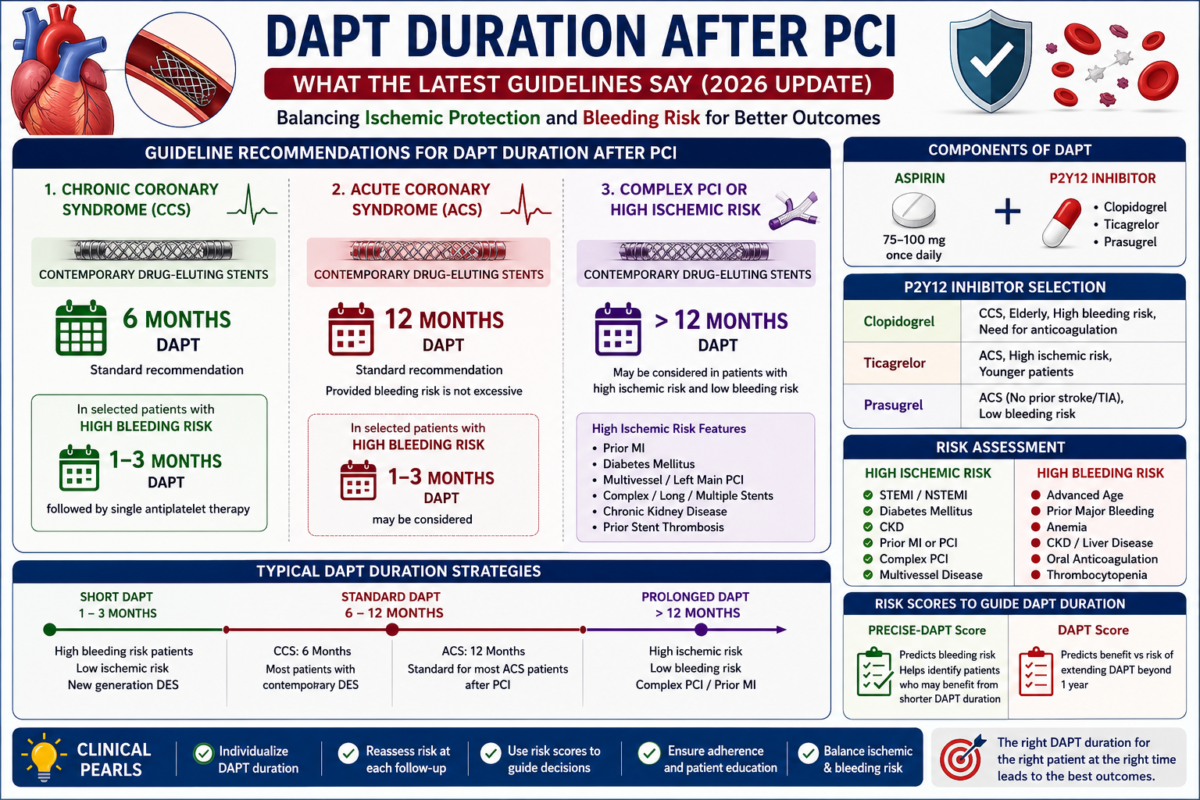
- 7. The DAPT-duration trials you must be able to name
- 8. Eight examiner traps in acute stent thrombosis questions
- 9. Practice MCQs with answers
1. The ARC definitions examiners expect verbatim
Marks are lost here for paraphrase. Learn the three certainty categories exactly.
- Definite — angiographic or autopsy confirmation of thrombus within or adjacent to the stent.
- Probable — unexplained death within 30 days of implantation, or myocardial infarction in the territory of the stented vessel without angiographic confirmation.
- Possible — any unexplained death beyond 30 days.
The commonest error is placing unexplained death at day 20 into “possible”. It is probable. The 30-day boundary separates probable from possible, not definite from probable.
2. Timing bands and their prevalence
| Category | Timing | Share of all events |
|---|---|---|
| Acute | < 24 hours | 0.5–4% |
| Subacute | 24 hours – 30 days | 5.3–15% |
| Late | 31 days – 1 year | 6–28.6% |
| Very late | > 1 year | 35.4–75% |
Two facts sit behind these bands, and both are commonly examined. Overall incidence with contemporary drug-eluting stents is approximately 0.5% of PCI cases. Very late events now dominate the total count, which surprises candidates who assume acute events are commonest.
The examiner’s follow-up is usually about lethality rather than frequency: 30-day mortality after an event approaches 25%, one-year mortality is around 14.6%, and ten-year mortality reaches 33.8%.
3. Mechanism by timing — the highest-yield table
If you learn one table for this topic, learn this one. Nearly every stem is solvable by matching the timing in the vignette to its dominant mechanism.
| Timing | Dominant mechanisms |
|---|---|
| Acute | Stent underexpansion, edge dissection, inadequate antiplatelet loading |
| Subacute | Premature DAPT discontinuation, inadequate antiplatelet response, residual mechanical problem |
| Late / very late | Malapposition, neoatherosclerosis, uncovered struts, delayed endothelialisation, in-stent restenosis |
A vignette describing a patient who stopped clopidogrel nine days ago and presents on day 14 is a subacute, pharmacological event. A vignette describing chest pain in recovery two hours after PCI with a heavily calcified lesion is acute stent thrombosis of mechanical origin.
4. Acute stent thrombosis numbers worth memorising
- Underexpansion increases relative risk roughly 13-fold and accounts for about 26% of early events.
- Malapposition is present in 18.1% of cases.
- Overlapping stents: 36.0% of cases versus 24.7% of controls.
- Bifurcation lesions: 45.5% versus 36.5%.
- Chronic total occlusions: 8.3% versus 3.3%.
- Calcification in late events: 52.8% versus 14.6%; it causes underexpansion in 31–58% of calcified lesions.
- Struts >162 µm are about 1.5× more thrombogenic than struts near 81 µm.
- Median time to thrombosis after clopidogrel cessation in the first six months: 9 days.
- Insulin-treated diabetes: early event rate 1.7% versus 0.9%.
- Recurrent events: approximately 12%.
5. Intravascular imaging targets
Minimum stent area targets are ≥5.0 mm² by IVUS and ≥4.5 mm² by OCT. Calcium features predicting underexpansion are an arc ≥180°, thickness ≥0.5 mm and length >5 mm — the classic OCT calcium score triad.
Trial attribution matters. ADAPT-DES (n = 9,961) linked IVUS guidance to lower one-year definite or probable events. RENOVATE-COMPLEX-PCI showed imaging-guided PCI reduced the composite of cardiac death, target-vessel MI and revascularisation in complex lesions. The 2025 ACC/AHA/ACEP/NAEMSP/SCAI ACS guideline recommends intravascular imaging to guide PCI in complex coronary lesions.
6. Antiplatelet pharmacology in the acute stent thrombosis question
Ticagrelor or prasugrel is preferred over clopidogrel in NSTE-ACS and STEMI patients undergoing PCI. Loading doses to recall: aspirin 150–325 mg, ticagrelor 180 mg, prasugrel 60 mg.
For intraprocedural cover, cangrelor provides immediate intravenous P2Y12 blockade with offset inside an hour — the correct answer whenever a stem emphasises vomiting, intubation or shock making oral absorption unreliable. Glycoprotein IIb/IIIa inhibitors remain a bailout option with high thrombus burden.
Anticoagulation is unfractionated heparin to an ACT of 250–300 seconds, or bivalirudin. For no-reflow after flow restoration, intracoronary adenosine 60–200 mcg is the standard stem answer.
7. The DAPT-duration trials you must be able to name
- DAPT trial — 30 months of therapy reduced ischaemic events but increased bleeding.
- STOPDAPT-2 — one month of DAPT followed by clopidogrel monotherapy.
- SMART-CHOICE — P2Y12 monotherapy after three months was non-inferior with less bleeding.
- TRITON-TIMI 38 — prasugrel versus clopidogrel, the classic potency-versus-bleeding trade-off.
Default duration after ACS is at least 12 months. Complex anatomy — left main, bifurcation, stent length over 30 mm — supports a minimum of 12 months with consideration of longer. The DAPT score guides extension: scores ≥2 favour prolongation, scores <2 favour stopping.
8. Eight examiner traps in acute stent thrombosis questions
- Assuming acute stent thrombosis is the commonest category. Very late events dominate the total.
- Placing day-20 unexplained death in “possible” rather than “probable”.
- Re-loading clopidogrel after an event that occurred on clopidogrel.
- Choosing routine aspiration thrombectomy. It reduces distal embolisation but not MACE, and routine use carries a stroke signal.
- Selecting a bioresorbable scaffold as the safer device. Older-generation scaffolds increased device thrombosis two- to four-fold versus everolimus-eluting stents.
- Forgetting that bare-metal stents have lower very late event rates than first-generation drug-eluting stents but not than contemporary ones.
- Attributing neoatherosclerosis to acute stent thrombosis. It is a late and very late mechanism.
- Reflex re-stenting when the real problem is underexpansion correctable by high-pressure post-dilatation.
9. Practice MCQs with answers
Q1. A patient presents 18 hours after PCI with ST elevation in the stented territory. This is classified as:
(a) Acute (b) Subacute (c) Late (d) Very late
Q2. Unexplained death occurring 22 days after stent implantation, without angiography, is classified as:
(a) Definite (b) Probable (c) Possible (d) Not classifiable
Q3. The mechanism most strongly associated with acute events is:
(a) Neoatherosclerosis (b) Stent underexpansion (c) Uncovered struts (d) In-stent restenosis
Q4. Minimum stent area target by OCT is:
(a) 3.5 mm² (b) 4.5 mm² (c) 5.5 mm² (d) 6.5 mm²
Q5. A vomiting, hypotensive patient with confirmed thrombosis needs immediate P2Y12 blockade. The best agent is:
(a) Oral clopidogrel 600 mg (b) Oral ticagrelor 180 mg (c) Intravenous cangrelor (d) Subcutaneous enoxaparin
Q6. Median time to thrombosis after clopidogrel cessation within the first six months is approximately:
(a) 2 days (b) 9 days (c) 21 days (d) 45 days
Q7. Which OCT calcium feature does not predict underexpansion?
(a) Arc ≥180° (b) Thickness ≥0.5 mm (c) Length >5 mm (d) Superficial location alone
Q8. Thirty-day mortality after an event approaches:
(a) 5% (b) 10% (c) 25% (d) 50%
Answers. 1 (a) — 18 hours falls inside the 24-hour window, so this is acute, not subacute. Timing stems are designed to be misread at speed. 2 (b) — within 30 days, so probable. 3 (b). 4 (b) — 4.5 mm² by OCT, 5.0 mm² by IVUS. 5 (c). 6 (b). 7 (d) — depth alone is not part of the triad. 8 (c).
A mnemonic for the correctable causes
D-U-M-P-I: DAPT non-adherence, Underexpansion, Malapposition, Platelet hyper-reactivity, Interactions and comorbidity. Every acute stent thrombosis management stem is answerable by naming which of the five the vignette is describing.
Go deeper: Browse the question banks and textbooks · Cardiology Learning Center · Clinical case discussions
References. Stent Thrombosis: A Contemporary Guide to Definitions, Risk Factors, and Management. Front Cardiovasc Med 2025;12:1622235. · 2025 ACC/AHA/ACEP/NAEMSP/SCAI ACS Guideline, Circulation 2025. · ADAPT-DES · RENOVATE-COMPLEX-PCI · DAPT trial · STOPDAPT-2 · SMART-CHOICE · TRITON-TIMI 38.

Pingback: Acute Stent Thrombosis: Bedside Reference