
Quick Notes in Practical Echocardiography – Book Release
How to Crack DM Cardiology Board: A Complete 6-Month Study Plan
Author: Dr A M Thirugnanam
Introduction
The DM Cardiology Board Examination is among the most demanding superspecialty examinations in medicine. It evaluates not only theoretical knowledge but also clinical reasoning, ECG interpretation, echocardiography, coronary angiography, hemodynamic understanding, evidence-based medicine, and practical decision-making.
Success requires more than reading standard textbooks—it demands a disciplined strategy, continuous revision, regular self-assessment, and familiarity with current international guidelines.
Many candidates fail not because they lack knowledge, but because they study without a structured plan. A carefully designed six-month schedule helps ensure complete syllabus coverage, repeated revision, and adequate practice before the examination.
This guide presents a practical, week-by-week study plan that balances reading, MCQ practice, case discussions, and clinical revision for maximum success.
Why a Structured Study Plan Matters
The DM Cardiology syllabus is extensive and includes:
- Coronary artery disease
- Heart failure
- Cardiac electrophysiology
- Structural heart disease
- Echocardiography
- Interventional cardiology
- Congenital heart disease
- Cardiac imaging
- Cardiac intensive care
- Preventive cardiology
- Hypertension
- Pulmonary hypertension
- Pericardial diseases
- Cardiomyopathies
- Valvular heart disease
- Vascular medicine
- Clinical pharmacology
- Cardiac emergencies
Without a timetable, candidates often spend excessive time on favorite topics while neglecting weaker areas.
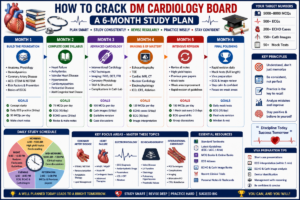
How to Crack DM Cardiology Board- The 6-Month Preparation Strategy
The study plan is divided into four phases:
Phase 1 (Months 1–2): Foundation Building
- Master core concepts.
- Read standard textbooks systematically.
- Understand disease mechanisms.
- Build concise notes.
- Begin daily ECG interpretation.
- Solve introductory MCQs.
Phase 2 (Months 3–4): Integration
- Correlate clinical cases with investigations.
- Interpret echocardiograms and angiograms.
- Revise guideline recommendations.
- Increase MCQ volume.
- Participate in discussions and grand rounds.
Phase 3 (Month 5): Intensive Revision
- Revise all notes.
- Focus on high-yield facts.
- Practice full-length mock tests.
- Review previous examination patterns.
- Strengthen weak subjects.
Phase 4 (Month 6): Final Polishing
- Daily rapid revision.
- Timed MCQ examinations.
- Viva preparation.
- ECG speed drills.
- Echo and cath image interpretation.
- Mental conditioning and adequate rest.
Month 1: Building Strong Fundamentals
Week 1
Study:
- Cardiac anatomy
- Coronary circulation
- Cardiac embryology
- Cardiac physiology
- Hemodynamics
Practice:
- 50 MCQs daily
- Five ECGs daily
Week 2
Focus on:
- Coronary artery disease
- Stable angina
- Acute coronary syndrome
- STEMI
- NSTEMI
Revise:
- Risk scores
- Revascularization strategies
- Antiplatelet therapy
Week 3
Study:
- Heart failure
- Cardiomyopathy
- Hypertension
- Cardiogenic shock
Interpret:
- Chest X-rays
- Echocardiograms
Week 4
Topics:
- Arrhythmias
- Syncope
- Bradycardia
- Tachycardia
- Pacemakers
Daily:
- ECG interpretation
- Rhythm strip analysis
Month 2: Completing the Core Syllabus-How to Crack DM Cardiology Board
Study:
- Valvular heart disease
- Infective endocarditis
- Adult congenital heart disease
- Pulmonary hypertension
- Pericardial disease
- Aortic diseases
- Preventive cardiology
- Lipid disorders
Daily goals:
- 75 MCQs
- 10 ECGs
- 2 Echo cases
Month 3: Advanced Cardiology
Topics:
- Interventional cardiology
- PCI techniques
- Intravascular imaging
- OCT
- IVUS
- FFR
- Coronary physiology
- TAVI
- Structural heart interventions
Practice:
- Angiogram interpretation
- PCI complication management
- Device selection
Month 4: Imaging and Electrophysiology
Master:
- Echocardiography
- Transesophageal echo
- Cardiac MRI
- Cardiac CT
- Nuclear cardiology
Electrophysiology:
- SVT
- VT
- AF
- Ablation
- ICD
- CRT
Daily practice:
- Five echo cases
- Five angiograms
- Five ECGs
Month 5: High-Yield Revision
Now avoid reading new textbooks.
Instead:
- Revise notes
- Read guideline summaries
- Practice previous papers
- Solve 150 MCQs daily
- Review mistakes
- Attend mock vivas
Month 6: Final Preparation
Every day:
Morning
- Rapid revision (2 hours)
Afternoon
- Mock examination
Evening
- ECG interpretation
Night
- Guideline revision
Complete:
- 5,000–8,000 MCQs before examination.
- At least 500 ECGs.
- More than 200 echocardiograms.
- Around 150 angiograms.
- Fifty comprehensive mock tests.
Daily Study Schedule
Morning (6:00–9:00 AM)
Fresh reading
High-concentration subjects
Mid-Morning (10:00–1:00 PM)
Clinical topics
Case discussions
Afternoon (2:00–5:00 PM)
MCQs
Previous papers
Evening (6:00–8:00 PM)
ECG
Echo
Cath images
Night (9:00–10:30 PM)
Revision
Flashcards
Guidelines
Essential Topics That Must Be Mastered
Coronary Artery Disease
Know:
- STEMI algorithms
- NSTEMI management
- PCI guidelines
- Antiplatelet therapy
- Lipid management
Heart Failure
Focus on:
- HFrEF
- HFpEF
- Acute heart failure
- Cardiogenic shock
- Advanced therapies
Electrophysiology
Master:
- ECG diagnosis
- Antiarrhythmic drugs
- Pacemakers
- ICD
- CRT
- Ablation
Echocardiography
Interpret:
- Valve disease
- LV function
- Diastology
- Pulmonary hypertension
- Prosthetic valves
Interventional Cardiology
Learn:
- PCI
- Complications
- Imaging
- Bifurcation PCI
- CTO
- Rotablation
- Mechanical circulatory support
Master Current Guidelines
Every candidate should know recommendations from major international societies on:
- Acute coronary syndrome
- Heart failure
- Valvular disease
- Atrial fibrillation
- Hypertension
- Lipid disorders
- Pulmonary hypertension
- Chronic coronary syndrome
Rather than memorizing every recommendation, understand the rationale behind major class I recommendations and common clinical algorithms.
How to Practice MCQs Effectively
Do not simply count the number of questions completed.
For each incorrect answer:
- Read the explanation.
- Revise the related concept.
- Record recurring mistakes.
- Reattempt similar questions after one week.
Quality of review is more valuable than quantity alone.
Preparing for Viva Examination
The viva tests clinical reasoning as much as factual recall.
Practice:
- Short case presentations.
- ECG interpretation within one minute.
- Echocardiographic image interpretation.
- Angiographic lesion analysis.
- Device identification.
- Guideline-based management discussions.
Develop concise, structured answers and support decisions with evidence when appropriate.
Common Mistakes That Lead to Failure
Avoid:
- Starting preparation too late.
- Reading too many textbooks simultaneously.
- Ignoring ECG practice.
- Neglecting imaging interpretation.
- Memorizing guidelines without understanding them.
- Failing to revise regularly.
- Skipping mock examinations.
- Poor time management.
- Inadequate sleep before the examination.
Resources Every Candidate Should Use
A balanced preparation should include:
- Standard cardiology textbooks.
- Current international guidelines.
- High-quality MCQ collections.
- ECG atlases.
- Echocardiography case libraries.
- Coronary angiography image banks.
- Recent landmark clinical trials.
- Structured personal revision notes.
One-Page Weekly Checklist
Each week aim to complete:
- ✓ One major textbook section
- ✓ One guideline update
- ✓ 500–700 MCQs
- ✓ 35–50 ECG interpretations
- ✓ 15–20 echocardiography cases
- ✓ 10–15 angiography reviews
- ✓ One mock examination
- ✓ One full revision session
Tracking your progress helps maintain consistency and identifies weak areas early.
Motivation and Mental Preparation
Preparing for the DM Cardiology Board is intellectually and emotionally demanding.
Maintain momentum by:
- Setting realistic weekly goals.
- Reviewing progress instead of perfection.
- Taking short breaks to prevent burnout.
- Exercising regularly.
- Sleeping 7–8 hours per night.
- Studying with peers when discussing difficult concepts.
- Staying updated without becoming overwhelmed by excessive new material.
Consistency over six months is far more effective than unsustainable bursts of intensive study.
Final Revision During the Last Week
In the final seven days:
- Review only your own notes and high-yield summaries.
- Solve a limited number of MCQs to maintain confidence.
- Revise ECG patterns, murmurs, valve lesions, coronary anatomy, and emergency algorithms.
- Avoid starting new textbooks.
- Prepare examination logistics in advance.
- Prioritize sleep and hydration.
Conclusion
Cracking the DM Cardiology Board Examination requires disciplined preparation, intelligent planning, and repeated revision rather than last-minute cramming. A structured six-month approach enables comprehensive syllabus coverage while building confidence in clinical reasoning, ECG interpretation, imaging, guideline-based management, and viva performance.
Success is achieved through consistency. Study every day, revise regularly, practice thousands of well-explained MCQs, interpret hundreds of ECGs and imaging cases, and continually assess your progress through mock examinations. With dedication and a systematic plan, candidates can approach the examination with confidence and maximize their chances of success.
Frequently Asked Questions (FAQ)
How many hours should I study daily for the DM Cardiology Board?
Most candidates benefit from 6–8 focused study hours daily, adjusted according to clinical responsibilities and consistency.
How many MCQs should I complete before the examination?
A target of 5,000–8,000 high-quality MCQs with careful review of explanations provides broad coverage and reinforces key concepts.
Which subjects deserve the greatest emphasis?
Coronary artery disease, heart failure, electrophysiology, echocardiography, interventional cardiology, valvular heart disease, and guideline-based management are consistently high-yield topics.
Should I read multiple textbooks simultaneously?
No. Complete one standard reference for each major topic, create concise notes, and rely on repeated revision rather than repeatedly starting new books.
What is the most effective strategy during the final month?
Focus on rapid revision, daily ECG and imaging interpretation, mock examinations, and guideline summaries while avoiding major new learning.
Internal Linking Strategy
Link naturally to:
- Home Page
- Cardiology MCQ Collection
- ECG Books
- Echocardiography eBooks
- Interventional Cardiology eBooks
- Heart Failure Books
- Board Examination Bundle
- Blog Archive
- Free Cardiology Downloads
- DM Cardiology Preparation Books