
No-Reflow and Slow Flow During PCI: A Complete Management Guide
No-reflow is the moment every interventionalist dreads. Why flow stops when the artery is open, how to tell the mechanisms apart at the table, and what actually restores perfusion.
Free cardiology articles, ECG and echocardiography tutorials, guideline summaries and board-exam revision material, written and clinically reviewed by Dr A M Thirugnanam, MD, MSICP, FSCAI, Ph.D., Senior Interventional Cardiologist and founder of the Academy of Elite Doctors.
The Cardiology Learning Center is the teaching arm of CardiologyBooks.com. Every article here is written the way cardiology is actually practised: a systematic method you can apply at the bedside, the measurement thresholds that genuinely change management, and the guideline positions examiners expect you to be able to quote. Nothing is written to fill a page.
Articles are revised as ACC/AHA, ESC and ASE guidance moves, so a reference chart you used last year does not quietly become wrong. Each article also links through to the book, bundle or course that covers the subject in full, which means the Cardiology Learning Center works either as free standalone reading or as the front door to a deeper syllabus.
Whether you are learning to read an ECG for the first time, reporting echocardiograms, revising for a DM, DNB, MRCP or USMLE cardiology examination, or managing cardiac patients from another specialty, start with the topic hub that matches your work. Every article is free to read.
Reading is the starting point. The same material is available in longer form as cardiology eBooks and bundles, as structured online courses, and as one-to-one mentoring for trainees planning a cardiology career.

No-reflow is the moment every interventionalist dreads. Why flow stops when the artery is open, how to tell the mechanisms apart at the table, and what actually restores perfusion.

Left main lithotripsy board revision: device comparison, trial tables, Shockwave C2+ IFU numbers, test inflation, EBU 3.5 guide choice and 5 exam MCQs.
A cardiology reference is only useful if you can find the answer during the ten minutes you have before the ward round reaches the bed. These books are written for that constraint — case-anchored, structured for lookup, and produced by a practising interventional cardiologist rather than a committee. The problem with most cardiology textbooks The

High-yield board revision on transcatheter tricuspid valve intervention: TRILUMINATE, Tri.Fr, TRISCEND II, TRI-SCORE bands, the 2025 ESC/EACTS and 2020 ACC/AHA recommendations, examiner traps and five single-best-answer questions with worked explanations.

ARC definitions, timing bands, the mechanism table, imaging targets and eight practice MCQs with worked answers on acute stent thrombosis.

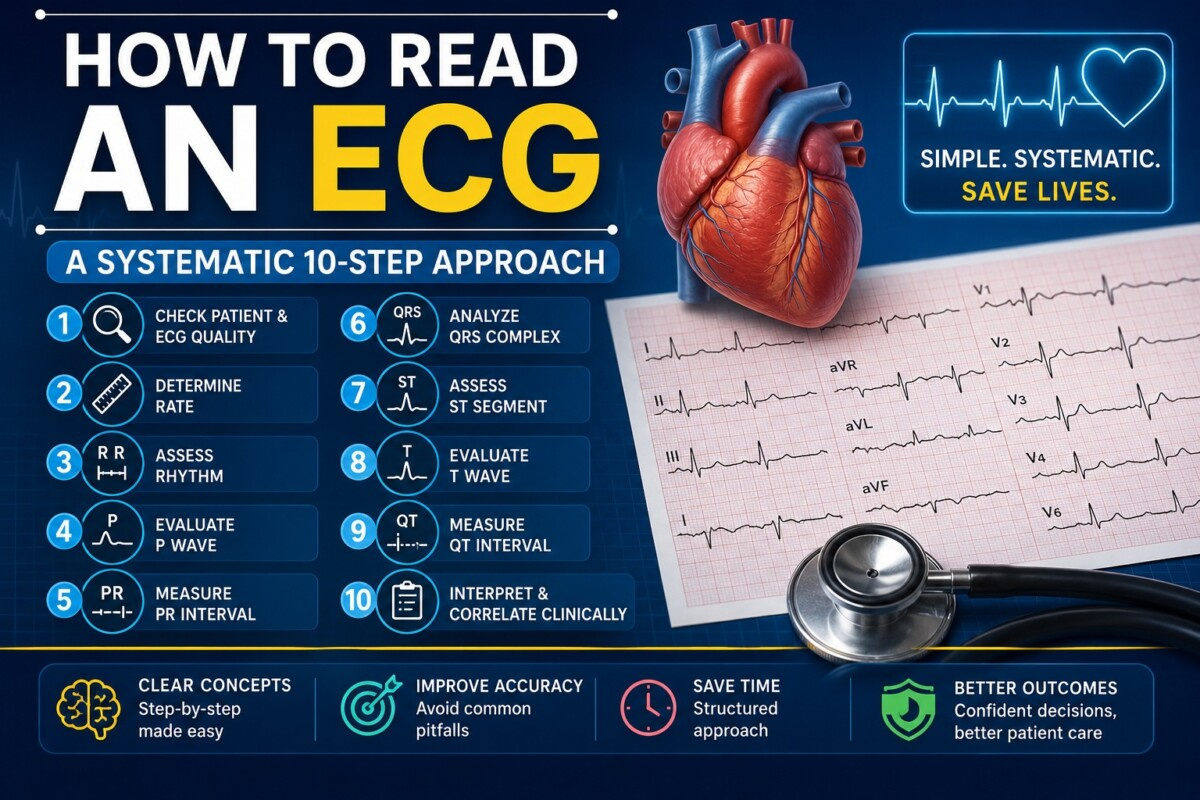
A fixed ten-step reading order for the ECG, the same sequence used at the bedside, so nothing gets missed because you found something else first.

Fifteen high-yield board questions drawn from current guidance, each with the full reasoning written out rather than just an answer key.

The adult normal values used in routine echocardiography reporting, gathered into one reference chart you can check against at the machine.

Six months turned into a workable cardiology board schedule, with weekly targets, revision cycles and what to stop doing in the final fortnight.
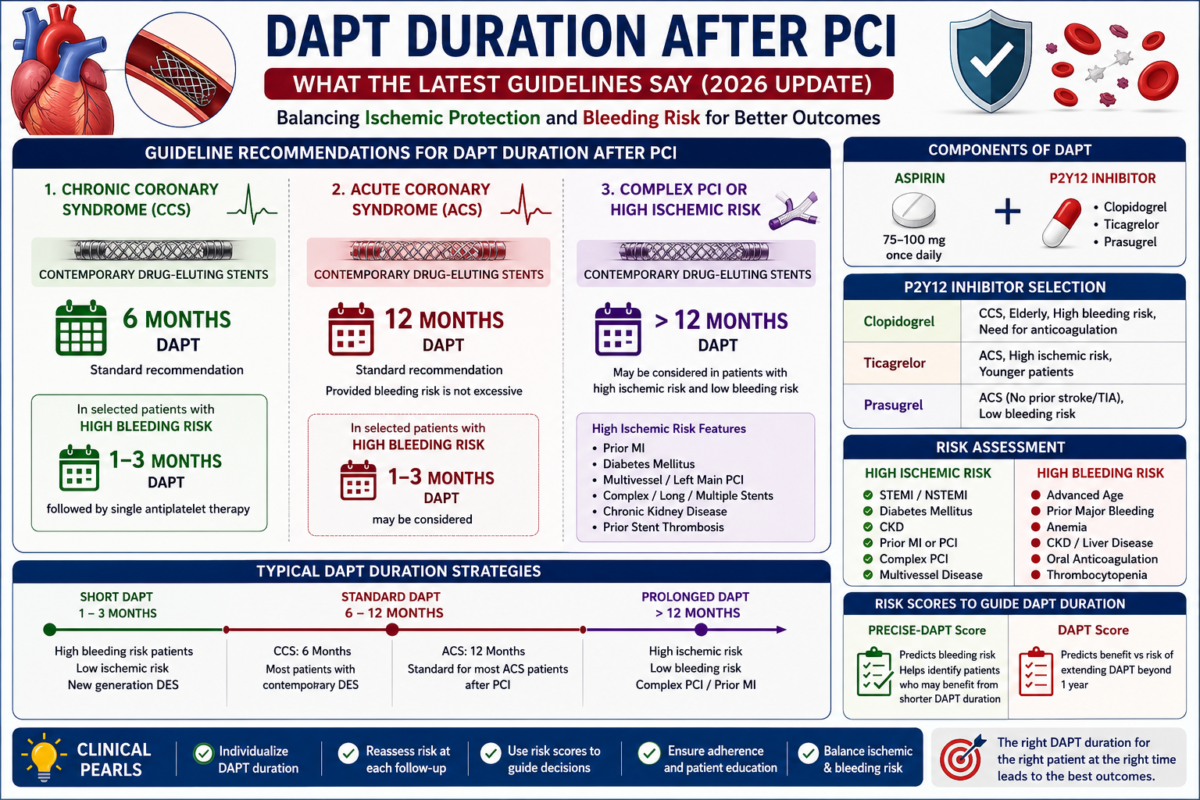
DAPT duration after stenting is a balance, not a fixed number. How ischaemic and bleeding risk pull against each other, and how current guidance frames the decision.
If you are starting from scratch, read in this order. Begin with the systematic 10-step approach to reading an ECG until the sequence is automatic, because almost every missed ECG finding is a sequencing failure rather than a knowledge failure. Then move to ECG changes in acute myocardial infarction, where pattern recognition carries real consequence.
Once the electrical picture is secure, add imaging: the normal echocardiogram values reference chart gives you the numbers that confirm or overturn what the ECG suggested. From there, treatment decisions become readable, and DAPT duration after PCI is a good demonstration of how bleeding and ischaemic risk are actually weighed against each other.
Candidates sitting an examination should run that reading alongside a schedule rather than after it. The six-month DM cardiology board study plan sets the pace, and high-yield board MCQs tell you honestly whether the reading has landed.
Every article is drafted or clinically reviewed by a practising senior interventional cardiologist before it is published, and each one names its author. Recommendations are traced back to primary guidance rather than to secondary summaries: the American College of Cardiology clinical guidelines, the European Society of Cardiology guidelines and, for imaging thresholds, the American Society of Echocardiography.
Where guidance genuinely disagrees, the disagreement is stated rather than smoothed over — a trainee who has only read the consensus version is poorly served in a viva. Where evidence is thin, that is said too. Articles carry a revision date, and reference material such as normal value charts is re-checked whenever the underlying guideline is updated.
Yes. Every article on this page is free to read with no registration. The paid material is the book, bundle and course catalogue, which goes considerably deeper than an article can.
Whenever the underlying guidance changes. Reference material — normal echocardiogram values, antiplatelet duration, exam-relevant guideline updates — is re-checked against the current ACC/AHA, ESC and ASE documents rather than left to age.
It is written with that in mind. Start with the board exam preparation and cardiology MCQ hubs, then use the six-month study plan to give the reading a schedule. For structured teaching, see the online cardiology courses; for individual guidance, the mentorship programme.
Dr A M Thirugnanam, MD, MSICP, FSCAI, Ph.D., with clinical review of every article before publication.
Dr A M Thirugnanam, MD, MSICP, FSCAI, Ph.D. is a Senior Interventional Cardiologist based in Hyderabad, India, and the founder of the Academy of Elite Doctors. He writes and publishes cardiology education for postgraduates, cardiology trainees and physicians in other specialties, and every article in the Cardiology Learning Center is written or clinically reviewed by him.
Read more about CardiologyBooks.com, see the author profile, or explore the cardiology book bundles and best-selling titles.