
DAPT Duration After PCI: What the Latest Guidelines Say
Author: Dr A M Thirugnanam
Introduction
Dual antiplatelet therapy (DAPT) has transformed outcomes following percutaneous coronary intervention (PCI) by substantially reducing the risks of stent thrombosis and recurrent ischemic events. DAPT consists of aspirin combined with a P2Y12 receptor inhibitor such as clopidogrel, prasugrel, or ticagrelor. However, prolonged therapy also increases bleeding risk. The central challenge for clinicians is selecting a duration that provides optimal ischemic protection while minimizing bleeding complications.
Recent international guidelines increasingly emphasize individualized treatment rather than a fixed duration for every patient. Advances in drug-eluting stent technology, intracoronary imaging, and risk stratification tools have allowed clinicians to shorten therapy safely in selected patients while extending treatment in those at high ischemic risk.
This review summarizes the current evidence and practical recommendations for DAPT duration after PCI.
Why Is DAPT Necessary After PCI?
Platelet activation begins immediately after coronary stent implantation. Until endothelial healing is complete, the metallic scaffold remains thrombogenic.
Dual antiplatelet therapy reduces:
- Acute stent thrombosis
- Late stent thrombosis
- Recurrent myocardial infarction
- Cardiovascular death
- Repeat revascularization
Without adequate antiplatelet therapy, early stent thrombosis carries a mortality approaching 30–45%.
Components of DAPT
Aspirin
- Loading dose: 150–325 mg (or according to local practice)
- Maintenance dose: 75–100 mg daily
P2Y12 Inhibitors
Clopidogrel
Preferred in:
- Chronic coronary syndrome
- Elderly patients
- Higher bleeding risk
- Requirement for oral anticoagulation
Ticagrelor
Preferred for:
- Acute coronary syndrome
- High ischemic risk
- Younger patients without contraindications
Prasugrel
Recommended in selected PCI-treated ACS patients without prior stroke or transient ischemic attack and when bleeding risk is acceptable.
Factors Determining DAPT Duration
Current guidelines recommend balancing two competing risks:
Ischemic Risk
Higher ischemic risk includes:
- STEMI
- NSTEMI
- Diabetes mellitus
- Chronic kidney disease
- Multivessel PCI
- Left main PCI
- Bifurcation stenting
- Long stents
- Multiple stents
- Prior myocardial infarction
- Previous stent thrombosis
- Complex PCI
Bleeding Risk
Bleeding risk increases with:
- Advanced age
- Anemia
- Prior gastrointestinal bleeding
- Chronic kidney disease
- Liver disease
- Need for anticoagulation
- Thrombocytopenia
- Frailty
Guideline Recommendations
Chronic Coronary Syndrome
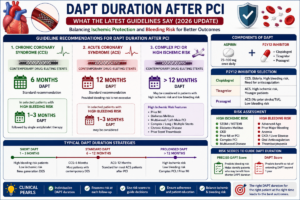
For most patients undergoing PCI for chronic coronary syndrome with contemporary drug-eluting stents:
- Standard DAPT duration: 6 months
In selected patients with very low ischemic risk and higher bleeding risk:
- 1–3 months of DAPT followed by single antiplatelet therapy may be appropriate.
Acute Coronary Syndrome
For patients presenting with:
- STEMI
- NSTEMI
- Unstable angina undergoing PCI
Standard recommendation:
- 12 months of DAPT, provided bleeding risk is not excessive.
High Bleeding Risk Patients
High bleeding risk patients require individualized treatment.
Evidence from contemporary trials supports:
- 1 month
- 3 months
of DAPT followed by single antiplatelet therapy in carefully selected patients treated with modern drug-eluting stents.
Potential candidates include:
- Elderly individuals
- Previous major bleeding
- Severe anemia
- Active cancer
- Chronic anticoagulation
- Frailty
Extended DAPT
Certain patients derive benefit from therapy beyond one year.
Possible candidates:
- Previous myocardial infarction
- Diabetes
- Peripheral arterial disease
- Multivessel coronary disease
- Complex PCI
- Diffuse coronary artery disease
- Prior stent thrombosis
Extended therapy may reduce recurrent ischemic events but increases bleeding risk. Decisions should be individualized.
Short DAPT Strategies
Recent studies have demonstrated that abbreviated DAPT followed by P2Y12 inhibitor monotherapy can reduce bleeding without substantially increasing ischemic events in carefully selected patients.
Potential advantages:
- Lower gastrointestinal bleeding
- Reduced intracranial hemorrhage
- Improved medication adherence
- Lower treatment costs
Choosing the Right P2Y12 Inhibitor
Clopidogrel
Best suited for:
- Stable coronary disease
- Elderly patients
- High bleeding risk
- Patients requiring oral anticoagulation
Ticagrelor
Preferred in:
- ACS
- High thrombotic risk
- Diabetes
- Complex PCI
Prasugrel
Most appropriate in:
- PCI-treated ACS patients without prior stroke/TIA
- Younger patients with low bleeding risk
DAPT in Special Clinical Situations
Elderly Patients
Consider:
- Shorter DAPT duration
- Careful bleeding assessment
- Individualized drug selection
Diabetes Mellitus
Diabetic patients often have:
- Greater platelet reactivity
- Increased restenosis
- Higher thrombotic risk
Longer DAPT may be considered in selected patients after balancing bleeding risk.
Chronic Kidney Disease
CKD increases both:
- Thrombotic events
- Bleeding complications
Treatment decisions should be individualized.
Oral Anticoagulation
Patients with atrial fibrillation undergoing PCI require careful balancing of ischemic and bleeding risks.
General principles include:
- Minimize duration of triple therapy
- Transition to dual therapy when appropriate
- Regular reassessment
Risk Scores Used in Clinical Practice
PRECISE-DAPT Score
Assesses bleeding risk using variables such as:
- Age
- Hemoglobin
- White blood cell count
- Creatinine clearance
- Previous bleeding
DAPT Score
Helps estimate the benefit versus bleeding risk of extending DAPT beyond one year.
Practical Treatment Algorithm
Chronic Coronary Syndrome
- Low bleeding risk → 6 months DAPT
- High bleeding risk → 1–3 months DAPT
Acute Coronary Syndrome
- Standard risk → 12 months DAPT
- High bleeding risk → Consider abbreviated DAPT in selected patients
Complex PCI
- Consider prolonged DAPT if bleeding risk remains low.
Common Clinical Mistakes
Avoid:
- Using identical DAPT duration for every patient
- Ignoring bleeding risk
- Continuing prolonged therapy without reassessment
- Premature discontinuation after ACS
- Failure to educate patients regarding adherence
- Overlooking drug interactions
Key Clinical Pearls
- DAPT duration should always be individualized.
- Modern drug-eluting stents permit shorter therapy in selected patients.
- Bleeding risk should be reassessed at every follow-up visit.
- Complex PCI often favors longer therapy if bleeding risk is acceptable.
- Shared decision-making improves adherence and outcomes.
Future Directions
Research continues to evaluate:
- Precision antiplatelet therapy
- Genetic-guided P2Y12 inhibitor selection
- Artificial intelligence-based risk prediction
- Personalized DAPT duration
- Novel antithrombotic agents with improved safety profiles
These innovations are expected to further refine post-PCI management over the coming years.
Conclusion
There is no universal duration of dual antiplatelet therapy after PCI. Contemporary guidelines support a personalized approach that integrates clinical presentation, procedural complexity, ischemic risk, and bleeding risk. While six months of DAPT remains appropriate for many patients with chronic coronary syndrome and twelve months remains the standard for most patients with acute coronary syndrome, shorter or longer durations may be beneficial in carefully selected individuals.
Regular reassessment during follow-up is essential, as patient risk profiles evolve over time. Optimal DAPT duration should always reflect a balanced evaluation of thrombotic protection and bleeding risk, with decisions guided by current evidence, validated risk scores, and clinical judgment.
Frequently Asked Questions
How long should DAPT continue after PCI?
Most patients with chronic coronary syndrome receive approximately six months of DAPT, whereas patients with acute coronary syndrome generally receive twelve months unless bleeding risk warrants a shorter course.
Can DAPT be stopped after one month?
Yes. In selected patients at high bleeding risk treated with contemporary drug-eluting stents, abbreviated DAPT followed by single antiplatelet therapy may be appropriate.
Who benefits from prolonged DAPT?
Patients with previous myocardial infarction, diabetes, peripheral arterial disease, or complex PCI and a low bleeding risk may benefit from extended therapy.
Which risk scores help determine DAPT duration?
The PRECISE-DAPT score helps estimate bleeding risk, while the DAPT score helps assess the potential benefit of extending therapy beyond one year.
Which P2Y12 inhibitor is preferred after ACS?
Potent P2Y12 inhibitors such as ticagrelor or prasugrel are generally preferred over clopidogrel in suitable patients with acute coronary syndrome, taking bleeding risk and contraindications into account.
Suggested Internal Links
Link naturally within the article to:
- Home page
- Interventional Cardiology eBooks
- Acute Coronary Syndrome resources
- STEMI management articles
- Antiplatelet Therapy guides
- Cardiology MCQ collection
- Cardiology blog archive
Suggested External References
Link to current guideline resources from: